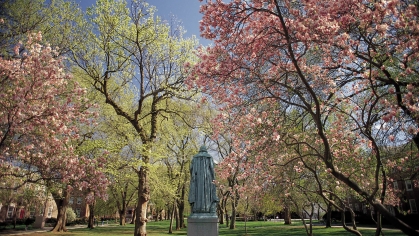
“Pretty scarlet,” says Peter Bridge, an alumnus of Rutgers School of Social Work.

Now 83, Bridge continues to show his loyalty by proudly displaying the Rutgers “R” on his car and supporting programming at the School. He describes his transformative years at Rutgers as “a wonderful experience spent among so many great teachers and colleagues," emphasizing that the lessons he learned extended far beyond the classroom.
Bridge arrived at Rutgers in September 1974 with high expectations, only to face an early setback. Upon arrival at the housing office on College Avenue, “nobody in that office had ever heard of me or several other international students who had been waiting there for a while.” This administrative mix-up resulted in Bridge and his peers spending several nights sleeping on mattresses at the International Student Center. Despite this rough start, Bridge recalls it was a quick and welcome bonding experience for students from all over the world. Within a week, all the students were housed, and then-President Bloustein hosted a garden party to welcome the group to campus.
During this period, Bridge also began his search for a practicum placement. Since he did not have a car, a fellow student and friend, Addie, invited him to accompany her on interviews. While traveling back from one such interview, Addie shared that a group of students were upset by Bridge’s admission to Rutgers. Bridge, who is white, hailed from South Africa. It was the height of apartheid, and the group of students called for Bridge’s acceptance to be revoked.
As Bridge recalls, “I asked Addie to let them know that I agreed both with their sentiments and their strategy,” referring to the broader anti-apartheid sanctions being placed on South Africa. “But I asked them to get to know me first. As both a priest and social worker, I was vehemently opposed to and actively engaged in working against the apartheid government,” which had clearly been part of the reason he received the IIE scholarship to study at Rutgers. Through open conversation with the group, mutual understanding prevailed, and Bridge continued his studies.
Bridge appreciated Rutgers’ unique educational approach, particularly its emphasis on seminar learning. “It was refreshing to experience a system that put a high value on seminars and shorter segments of learning,” he recalls. This structure allowed him the freedom to explore New York City and enjoy cultural experiences, all while maintaining his academic focus.
One of the highlights of his Rutgers experience was being invited by Professor Anne Adams to co-lead an anti-racism seminar. Although hesitant at first, Bridge soon recognized the value his perspective could bring. “Though the USA and South Africa are thousands of miles apart, the shared pain could not be closer,” he said.
A book, Justice-Love, that Bridge wrote many years later, incorporated lessons from that anti-racism seminar as well as from his experiences as a priest in apartheid South Africa. As he describes in his book, “radical empathy” is the key to understanding and promoting justice. He believes that “our very existence is bound together with each other and with all beings,” echoing the concept of “ubuntu” from South Africa: “I am because you are. You are because I am.”
After graduating, Bridge’s connection to Rutgers continued through the years. He was honored to be invited to preach at the interfaith service celebrating Rutgers’ 250th anniversary. In his sermon, he stressed, “A university has a prophetic role to play when it comes to justice for all.” He remains proud that his alma mater continues to embrace that role.